Showing posts with label Community. Show all posts

Monday, November 23, 2009

New Job. New Home.

I have big news! I have just accepted the position of Director of Community for Answers.com (focusing on WikiAnswers). I'll be leading a distributed team of 5 folks who have about 15 assistants and nearly 700 volunteers across the globe who are supporting nearly 4 million registered users and over 50 million visitors a month. Whew!

As part of the job, I must move to New York. It was not an easy decision to make. I will be moving away from my mother (two hrs away in Merced), good friends, a nice cheap rental in Hayward, and many, many professional friends, colleagues and peers. I will miss seeing them as often as I do now, but I look forward to keeping connected through all our virtual connections.

On the other hand, I am moving six hours and $300 closer to Europe. Also, I will be closer to a number of places that are of interest to me such as the Philadelphia (Mütter Museum and The College of Physicians of Philadelphia) and the National Library of Medicine in Bethesda, MD. I look forward to trips north and south exploring the other coast.

At the center of this, though, is the work to be done. Answers.com is pretty cool and energetic. I get to work with an existing community and staff and help everyone grow and become more empowered at helping answer other people's questions. I look forward even more to how I can help make that happen better, faster, with more people helping each other.

I NEED YOUR HELP!
If you can help me with the following please contact me:
  • Friends/family who live in NYC, especially Brooklyn, who can help me understand the neighborhoods.

  • Friends/family who are in real estate, property mgmt, or can recommend a broker in NYC who can help me find a place and understand the ins and outs of renting.

  • Recommendations for national movers to help me get the few very precious things I will take with me to NYC safely.

I know this is a surprise to some folks (what else is new) so I hope to answer a few questions. If I miss one you have, add it as a comment or shoot it to me and I will answer!

When do you start?
I start sometime mid-January 2010. I want to finish up some client work and there is a very special winter camping event I want to attend.

When do you move?
No later than mid-February 2010. I hope to have a place lined up by Feb 1 so I can concentrate on my move. I'm not sure if I will be able to stay for my birthday (Feb 19), though.

Do you have time to take on any online community work?
I regret that as of now, I am unavailable to accept any client work. If you wanted to talk about possible work, I do know many online community people who are looking for clients and I would be happy to match you up with one of these fine people.

Why do you want to leave California?
It's not that I want to leave California. It's that working on a project like Answers.com and WikiAnswers is a huge opportunity to be a part of something that will have an impact on people. I recognize that to do the job well, I need to be closer to the people in New York and the office in Israel.

Where are you going to live?
I'm not sure. Brooklyn looks and feels a lot like Oakland and so I am looking there first. I also am not ready for the shock of Manhattan apartment prices. If you know anyone who lives in Brooklyn and can offer me advice on neighborhoods, please let me know!

Can stay at your place when I come to New York?
Sure! As long as you don't mind that I will not be in Manhattan. I will look for a place that will give me enough room for office/guests so please come make use of the space.

Can I have your stuff?
I definitely have to shed stuff from my life. If there is something particular you have been coveting, ask!

Are you giving up the VW Thing?
Yes (sniff!). It's time I come to terms with the fact that I don't have the drive to get the poor darling restored like it deserves. She's been good to me and I'll be looking for a good home ASAP.

This is big, really big. So did I miss a question? What do you want to know that I haven't already said?

photo of brooklyn bridge by See-ming Lee

Tuesday, August 11, 2009

The lost origin of an online holiday

For the past three years, I have been wanting to tell my version of a holiday called Fern Day that is unique to the citizens of a virtual world called Dreamscape which is coming up on its 14th year of operation (I blogged about its 10th Anniversary before). It’s the story of how something I helped start was adopted by a community and became a custom or kind of cultural norm that is practiced annually without connection to its deeper origins.

What is Fern Day?
On Aug 1, 2009, Fern Day was celebrated over the course of two days by the inhabitants of the city of Phantasus on the island of Kymer in a dream-like world called Dreamscape. Two full days of games developed and run by the world-wide community with virtual items given as prizes. And by “full-days” and “world-wide” I mean there are multiple games scheduled each hour from 1am to 11pm which implies multiple time-zones are involved. Additionally, there is a parade through the streets of Phantasus, a dance contest, a blessing of the Ferns, several ceremonies and retellings of the True History of Fern Day.

How Fern Day Started
I don't want to take away from what Fern Day is for the citizens of Phantasus and the inhabitants of Dreamscape, I hope that this secret origin of Fern Day will help other community managers and facilitators see ways they can instigate cultural changes in their own communities that will be accepted and adopted by the community members and become part of the cultural make-up of how those communities identify themselves.

About a month before the first Fern Day was celebrated, Aug 1, 1996, I was one of three community managers (called Oracles) who was trying find a holiday to celebrate during the month of August. The Dreamscape had been operating for just under one year and we knew early on that we wanted to celebrate existing holidays in a way that separated the Dreamscape from the everyday, offline and modern, “waking world”. We recognized that there would be pressure from the modern people inhabiting this virtual world to bring with them the holidays of their culture, nationality and religions and we didn't want to become caught up in disputes (which happened anyway and is another story for another time). Finally, we wanted to recognize natural cycles we cannot avoid, the cycles of the hours, the days, weeks, months and seasons because such cycles help tie people to places, and each other. So, we planned early on to include at the very least recognize holidays on a regular basis.

It was the nature of the Dreamscape that members of the community could not create objects or artwork on their own as one can today in Second Life or as one could in Active Worlds in 1996. This meant that all artwork was created by our company. In order to avoid overloading the art pipeline with holiday artwork, we planned to celebrate holidays every two months for one year, shift one month and keep going for another year. That way, in two years, we would have 12 holidays and could recycle art each year (that ultimately was doomed because we needed to refresh or create new art every year to keep interest up). Thus, Christmas, Chanukah and Kwanza were rolled together into a month-long winter fest (which included a very secular Santa Claus (called Kymer Kringle) and a nod to C. S. Lewis’s White Witch) .

So it was in July of 1996, I was looking for a holiday or set of holidays to appropriate and remix to our budding virtual world. Not finding much, I learned about Australia’s National Wattle Day, held Sept 1. Learning that it was a fairly new (less than 100 yrs old) holiday gave me the inspiration to, uhm, appropriate it. I moved it to August 1st and latched on to the only local flora the Dreamscape had in abundance, the fern which was purchasable in a vending machine for 160 Tokens (the virtual currency).

At the next meeting of the three community managers, the question arose, "What are we going to do about a holiday in August?". I suggested we celebrate "Fern Day". My compatriots looked at me confused and, figuring that the only way this would work is to be so over the top that it will take root, I continued like a carnival barker. "It will be fernomnonal! A full day of fernvolity, celebrating the ferntastic fern-ness of the fern." I may have concluded with, "unless someone has a better idea". Having done my research into the dearth of non-nationalistic holidays for August, I figured there would be none. It took no time for them to start fern puns of their own and the idea took root. Planning for the first Fern Day started.

On July 31, we publicly announced Fern Day with this message:
What: Phantasus Fern Festival
When: August 1st
Time: All day
Where: The streets of Phantasus
Hosts: Oracles and Acolytes

Come one, come all!

Help celebrate Phantasus Fern Day--The Dreamscape's first "official" in-world holiday! We will be celebrating with new vendos, new items, and of course...ferns! Bring your ferns or purchase new ones! Search amongst the foliage for hidden items! Fern Fun all day long!

The main idea is to have fun with ferns. There will be improptu [sic] games and visits by all three Oracles throughout the day. Here is a schedule of a few events:

9:00 AM WAT - Opening
Ceremony Outside the Temple

Noon WAT - Fern Tag (Meet at Temple Street Terrance Lobby)

1:00 PM WAT - Drawing for prizes of players in Fern Tag

5:00 PM WAT \
- Blessing of the Ferns
5:30 PM WAT /

9:00 PM WAT - Closing Ceremony Outside of Temple
(WAT means Worlds Away Time which happened to be set the same as the servers)

and got exactly the same reaction from the community that I had gotten from my teammates. Our volunteer moderators (called Acolytes) were really at a loss to explain why all three community managers had just gone collectively insane. We chose not use the rational (and real) explanation of appropriating Wattle Day and instead flooded our poor volunteers with fern-puns, silly enthusiasm, and vague references to the "ancient origins" of a holiday that, until that moment, none of them had ever heard of. In other words, we used the time-honored justification of many cultural customs, "Because that's the way it's always been done".

The First Fern Day
Come August 1, 1996, the citizens of Phantasus were tentative about what was happening, but they became enthusiastic when the price of ferns were dropped from ~160 Tokens to a mere 10 Tokens. The scheduled game of Fern Tag was simple: find someone without a fern, give them a fern and them drag them to the game host who would record both names as part of a raffle. People were buying ferns fast and furious and zipping around the world handing them out and drawing more innocent bystanders into the chaotic whirlwind of fern-ness.
Then disaster struck. It seemed that there was a memory leak with the vendos that dispensed ferns. But this memory leak was on the *server* side. That means that the more people bought ferns, the slower and slower the servers hosting the entire virtual world were running until they eventually crashed, booting everyone out. Even when the world was brought back, it immediately crashed again. It looked like it would take many hours before the world could be brought back up so fern day would be over before it had a chance to even exist. People were feeling left out and understandably angry (likely the most angry were the poor developers who gave us no end of grief over what turned out to be an unscheduled load test on a Saturday). There was only one thing to do: apologize and make amends.
Dear Dreamscape Customers,

This is a letter to discuss the most recent and unfortunate events which occurred on Fern Day.

The terrible problems we experienced with our servers on what was quickly turning into an extremely festive occasion was as emotionally draining for us as it may have been for you. The Dreamscape was unavailable from 2:00 AM WAT - Noon WAT and from 2:00 PM WAT - 8:00 PM WAT. We have been working continuously to find the source of the problem and make the Dreamscape available to you. Unfortunately, at this time, we have been unable to determine the exact source of the problem. We are still investigating the situation and have implemented some changes which should keep the service stable. We deeply regret the inconvenience and imposition on the fun promised.

The Oracles have every intention of getting as much out of Fern Day as we hoped. To this end, we have extended the Fern Day Festival to Noon, August 2. We encourage you to come out as often as possible during the next 16 hours to celebrate Fern Day as we had intended to celebrate. We hope that those who had initially captured the spirit of Fern Day will regain it and sponsor or participate in the variety of games which were spontaneously popping up. At Noon, there will be a closing ceremony at the Main Doors of the Temple and soon after, the vendos will be removed from the streets. Even after this, we hope you will enjoy the ferns you have and the good memories which we will all share.

The Oracles and the Forum Sysops thank you for your generous patience and support in this matter and wish you a very happy Fern Day! We would also like to thank the Acolytes and the Forum Staff who helped out so much during the times in which the Dreamscape was unavailable.

Most sincerely,
Oracle Uni
Oracle Vaserius
Oracle Teresias
WorldsAway Community Forum Sysops
WorldsAway Team

from SUCKUP.TXT
The next day, folks turned up, amends were made, and the new closing ceremony included a recognition of the troubles we had all encountered. As an aside, it also meant that two community managers came in for an extra day of work when only one had been regularly scheduled (this is what you do when you are in customer and community service). Fern day was wrapped up, prices returned to normal, and we put it away until the next year.

How Fern Day really started
The next year, in preparation for the second annual celebration of Fern Day, Marianne G, who ran one of the newspapers for the virtual world posted a story of the "true history" of the origins of Fern Day which included the nickname “Crash Day”. We, the community managers, knew none of us had a hand in her history but it took only seconds to agree that we would support and even adopt her story as the origins. To do otherwise would discourage creativity and we thought her version was as good as any so we took the same, "because that's the way it's always been" attitude. Aug 1, 1997 was my last Fern Day in Dreamscape. In another two years, the last of the original community managers who stared blankly at me that July day had also moved on.

But by 1999, the community had claimed Fern Day as their own and over the next 10 plus years, the citizen-created history, games, parades, and ceremonies have evolved to include early beta testers (who never received official recognition for being pioneers – mea culpa) and even a group who call themselves Natives and claim to have inhabited this virtual world before even the beta testers. It's literally taken directions I never imagined it would. I could not be happier about it.

Monday, August 10, 2009

OCTribe Call for Participation - Tuesday Topic

How OCTribe works
Each 2nd Tuesday and 4th Tuesday of the month, one of the bloggers in the loosely defined OCTribe group makes a call for posts related to a particular topic of online communities. Then the same blogger posts a summary and links to the submissions.

Write something related to the topic tomorrow (Tuesday, August 11), tag it #octribe, and your post will be linked from the recap page. This conversational project is just starting, so please join in!

The Aug 11 Topic: Fostering culture in and around online communities
Share your experiences and ideas around any of these:
  • fostering or identifying emerging customs or taboos in an online community (for example, here's a story of an academic who discovered "that game rules encouraging competition and varied tactics hardly mattered to gaming community members who wanted to preserve a deeply-rooted culture."
  • establishing or fostering culture within the organization hosting an online community
  • culture clashes between online communities or between community and host organization
  • offline and online culture influencing each other (for example, the prevelance of caste based groups on Orkut as a mirror of India's society

You might also find inspiration from Forum One's Online Community Culture study conducted Oct 2008.

How to participate:
  • Post your thoughts on online communities and culture sometime between now and Tuesday, Aug 11.
  • Tag your posts, tweets, photos, slides with #octribe
    - shoot me a quick email to make sure I include your post in the round up.
  • Come back Wednesday, Aug 12 to see what your fellow Online Community Tribe members have to say.
If you would like to host a future OCTribe topic, email Bill Johnston.

Tuesday, July 28, 2009

Create value metrics for both host and community

This post is part of the OC Tribe series. Each 2nd Tuesday and 4th Tuesday of the month, online community practitioners are be encouraged to explore a particular topic via blog, video blog, twitter, or whatever suites their fancy. The topic for Tuesday, July 28 is Valuing Participation in Online Communities. Check the post and tag your musings with #octribe. A recap will be hosted at the originating blog later this week. This ad-hoc group is just starting up, so please join in! #octribe

Some discussion of assigning value to members in a community tend toward how valuable a particular community member is to the host of the community (be they a brand, reseller, or even non-profit). This often raises concerns that community members are being taken advantage of. The AOL volunteer lawsuit gets thrown out as one of the third-rail types of stories -- danger! do not touch! What is often lost is that AOL ran volunteer programs for a long time before the lawsuits with few issues. What changed? Part of the answer is that AOL was using free access as a perk for their volunteers. However, when AOL went from a rated service (access charged by the hour) to a flat-rate (unlimited access for a monthly fee), the value of that perk plummeted. It's not the whole reason some volunteers stood up against AOL, but it certainly added to some of the resentment.

What if we add another level to the idea of ascribing value to the contributions of a community member? Let's say we are a bookseller. People who write reviews are valuable to our business, not because they buy books in large quantities (in fact, we might even send them books to review), but because their reviews help sell books to people who will appreciate them. Even by steering some people away from a book, the reviewer can help the bookseller build long-term relationships with book buyers. It's pretty easy to see who we might ascribe a value to the reviewer -- sales of books after viewing a particular review (or, better, after marking it "helpful" and then going on to purchase the book).

So where's the value to the reviewer? Part might be that the seller puts high-value reviewers at the top of promotional book give-aways. So reviewers get more books. Reviewers might even be allowed a small percentage of the sales of books they review. And, of course, there is notoriety in being a highly ranked reviewer.

Is there value for the community at large, particularly, those community members who might not receive a high valuation in this scheme. Perhaps so. After all, they want to spend their money wisely and so are likely to also find the high-value reviewers helpful, useful, valuable.

Granted, I cherry-picked a fairly easy business and model for my example, but I challenge my fellow community managers and facilitator. What other kinds of positive feedback loops can we create that build value for different aspects of our communities such that even if the value were quantified as a number, people would still be willing to contribute?

Thursday, June 18, 2009

Some notes on Sway by the bros. Brafman

Recently, at a webinar, Francois Gossieaux recommended the book Sway by Ori & Rom Brafman. I decided to take the rest of the afternoon off and see if the Hayward Public Library had a copy. They did and it was such a slim book and a quick read that, well, here we are.

As I read the first few chapters, the authors introduced terms such as "value attribution" and "diagnosis bias". The descriptions sounded familiar as Fundamental Attribution Error and Confirmation Bias, so I googled the terms and, lo, found very little in the way of formal definition of their terms. While I think the concepts in the book are very interesting, I admit I am a bit annoyed at dressing up known or familiar concepts in new terms without acknowledging or improving upon the terms or concepts.

So here's a very short summary of the concepts in the book with more common terms and links where I could find them.

Chapt 1 - aversion to loss - Sunk Costs Fallacy

Chapt 2 - commitment (even in the face of mounting loss) - Escalation of Commitment

Chapt 3 - value attribution - Fundamental Attribution Error

Chapt 4 - diagnosis bias - Confirmation Bias

Chapt 5 - chameleon effect - Pygmalion Effect & Golem Effect

Chapt 6 - process justice - Perceptions of fairness and The Ultimatum Game

Chapt 7 - the paradox of rewards - neuroscience of personal pleasure (Brian Knutson) and altruism (Dharol Tankersley). prospect of reward is stronger pleasure center stimulant than receiving the reward.

Chapt 8 - group conformity and dissenters - Asch conformity experiments

Epilogue - advice on avoiding each of the above "sway" forces. However, advice on avoiding being swayed by rewards was not included. I would have liked to see much more on this with the advice backed by research.

I'm glad I read Sway, it's a bit like a crib sheet of behavioral psychology and economics, so it works as an introduction, but there are deeper resources out there and I'm looking forward to digging into them.

Monday, April 27, 2009

Questions to Ask When Building an Online Community

Today, I am attending the NTEN Conference 2009 and speaking on a panel, "Building and Sustaining Vibrant Online Communities".

This is the 15-20 minute presentation I will give. I recommend clicking through to the full view so you can see my notes on the slides. I'd love to hear feedback on the questions (and special thanks to Brooks Brown and Mike Rowland for feedback on the draft).

Update: Lessons learned. This was not a 20 min presentation. The slides may be simple, but my supporting details were, well, detailed. I guess that's good. I'm thinking about presenting this at the Online Community Unconference, June 10th. If you have an opinion on that, let me know.

Tuesday, February 17, 2009

Social Psychology 101 for Community Managers

These are my speaking notes for my session at the Online Community Unconference East 2009. I believe the wiki is publicly available for viewing.

These are totally messy. I am trying to break my desire for unattainable perfection and allow drafts of my thoughts to be out there. If there seems to be interest, I may turn these into a better formatted series.

Intro
- I am not a social scientist, just a Community Manager who has been learning as I go.
- I want to share the moments of, "I know that! It has a name?" with you.
- The format is definitions, examples and some practical applications.
- The main goal is to get you started in learning from other disciplines.
- The secondary goal is to improve ourselves as community managers and participants as community members.

(Additional notes: there is a community manager in Poland named Darek Kłeczek who blogs at Leadership in Social Networks. I came across his post, 10 Social Psychology Tips for Managing Online Communities while searching if anyone else had approached this topic yet. He's worth keeping an eye one as he develops ideas about how we can encourage leaders to develop in our communities.)

-----------------------------
Fundamental Attribution Error
-----------------------------
Definition:
People tend to presume the actions of others are indicative of the "kind" of person they are rather than their actions being caused by a situation.

Based on experiment by Edward E. Jones and Victor Harris (1967). Coined by Lee Ross (1977). Sometimes called "correspondence bias", but not by all social scientists.

Examples:
- Community makes error against their own: First time posters who make a social mistake being considered a troll.

- Community applies attribution error to community host: Considering the host uncaring/out of touch when tech changes occur suddenly or when the host makes a decision about Terms of Service (accused of playing favorites).

Reducing the Effect:
The attribution error occurs usually because there is not enough information about the situation. Studies have shown that when victims of crime learn more about the criminal's circumstances views tend to shift from desiring harsh penalties to compensation for losses.

To prevent yourself from committing the fundamental attribution error, gather situational information:
- Do people tend to behave the same way in the same situation?
- What would I do in the same situation?
- *Ask* the person for help in understanding their situation.

To reduce the effect when others are applying the fundamental attribution error to you, disseminate the situational information.
- publicly realign yourself/your org with community goals/values.
- clarify the way the situation is leading to types of behavior.

Examples:
- ask potential spammers for personal situation before assuming they are evil. (They may be enthusiastic and not realize the norms of your community)

- Explain situation behind any changes to your community before the changes are implemented. (You may also enlist aid from community to float preferable changes.)


--------------------------------------------------------
INTERMISSION: A note about conflict management/mediation
--------------------------------------------------------
I will not be covering conflict management or conflict mediation, though many examples involve these skills. I am willing to help anyone with questions about resources. For the wiki, this might be a good place to compile some resources.


-----------------------------
Actor-observer bias
-----------------------------
Definition:
We tend to attribute our own behavior to the situation, but the behavior of others to the "kind" of person they are.

Developed by Edward E. Jones/ Richard E Nesbett (1971) as the flip side of Fundamental Attribution Error.

However, Bertram F. Malle questions actor-observer bias because of a lack of evidence (2006).

Example:
- "I am not a bad person."

Reducing the Effect:
- Awareness that this may be happening (on your part, on the part of the person judging you, on the part of two community members towards each other).

- Use the same methods as the Fundamental Attribution Error: learn more about the situation.

Examples:
- This is as much about self-reflection as it is observation of others.
- I once had an argument with a vendor that seemed to be about their customer service attitude when the truth was I (and our organization) were asking more than the vendor could give. Realizing this allowed us to enter future vendor deals with realistic expectations, fewer conflicts and better results.


-----------------------------
Confirmation Bias
-----------------------------
Definition:
We tend to look for, or better remember, information and evidence that supports our preconceptions and avoid/overlook/forget evidence that counters our beliefs.

Examples:
- Good luck charms, people who believe in psychics/cold readers, belief that a computer problem is because of a virus transmitted by your web site

Reasons:
- We may be wired this way. If a successful survival strategy works, it's better to repeat the strategy than experiment. If a prehistoric tribe succeeds in hunting a deer, they are likely to stick with it rather than risk going hungry. But it's a short jump from attributing the successful hunt to a pretty stone instead and thus the good luck charm is born.
- The person facing evidence to their belief may feel shame, stubbornness or hope.
- Other factors that may filter counter-evidence may include tradition, taboos, religion, ideology.

Reducing the Effect:
- View information impartially. Welcome counterarguments. ("Strong opinions, loosely held" - ******** )
- Combating this in yourself: imagine a deamon, similar to Maxwell's Deamon that acts as a gatekeeper to your senses, allowing agreeing facts in and deflecting facts that counter your beliefs. (aka Morton's Deamon)


-----------------------------
Social Facilitation
-----------------------------
Definition:
We tend to do simple tasks that we know well better with an audience than alone. But, we tend to do new or complicated tasks worse in the same situation.

Examples:
- Performance anxiety

Reducing the Effect:
- Encourage practice.
- Provide graduated experiences such as encouraging poll voting or rating before submitting opinions, reviews or other content. Also, allow people to create content and control ever-widening circles of who sees the content.
- Compliment when a new or difficult task is *attempted*.

Examples:
- Warm welcomes without correction when someone contributes for the first time.


-----------------------------
Social Loafing
-----------------------------
Definition:
When work is pooled and individual performance is not known, people in groups tend to put in less effort.

Reducing the Effect:
Reveal individual performance for simple tasks (to avoid problems in Social Facilitation). For complicated tasks, keep performance private until proficient.

Examples:
- Badges in online game systems. Simple acknowledgment of simple accomplishments and difficult accomplishments. People sometimes complain when a game does not provide badges showing the power of revealing individual performance.


-----------------------------
Bystander Effect
-----------------------------
Definition:
Individuals are less likely to offer help in an emergency situation when other people are present.

Specific to online communities, groups don't handle conflict situations when there is a perception that someone else will handled it faster or with more authority.

Originated around Kitty Genovese who was stabbed to death in 1964 and "no one helped". The story is dramatic, but not entirely true. The media failed to contact the police for information before reporting the story and possibly committed confirmation bias in avoiding information undermining the belief in the bystander effect. In fact, the police were contacted at least once during the attack and "bystanders" heard, but could not see the attack.

The Bystander effect was demonstrated in experiments in 1968 by John Darley and Bibb Latane.

Examples:
In the late 80's the a gaming service called The ImaginNation Network was having problems with users harassing each other. There was no formal reporting process so members were a bit on their own with few ways to contact the service. The service added a "report abuse" button and, quickly, the number of reports increased. The members stopped trying to resolve the problems themselves and resorted to the abuse button first.

Reasons:
- Social influence. We tend to look at how others are reacting in situations for cues on what to do. If everyone is waiting to see what others do, no one will act.
- Assumption that others will intervene and feel no special responsibility.
- Fear of being evaluated (Social Facilitation), embarrassment, or being superseded by someone more skilled.
- Uncertain help is wanted.
- In online communities, when authority moves fast or decisively.

Reducing the Effect:
- As a Community Manager, drag your feet a little. Give the space for others to step in and encourage them when they do. (Once I had someone who was great at helping in the community in a specific way, he was so fast and so good, others were commenting on him "beating them to it". I praised him for being a great example and ask him to be a little slower off the mark. When he did, others were able to step in. This took the pressure off him and eventually lead to a strong culture of helping in a specific way.)
- As a Community manager, do not use your admin tools first or often. Resolve conflicts publicly as a way to demonstrate to others how they too can handle them. This woudl be a literal empowerment of your community.
- Instill a sense of responsibility and empower the members by following up when they help or get in over their heads. Allow the community to help you spot spam and deal with items they flag. IF someone attempts to resolve a conflict and has trouble, then step in (and later privately help the person improve their skills).


-----------------------------
Other social theories
-----------------------------
These were not covered during the session. They are presented briefly to provide some background to common terms a community manager will encounter as they read deeper into social psychology and sociolgy.

-----------------------------
Small World Experiment
-----------------------------
- Stanley Milgram
- Average path length for social networks
- Dropped letter with a note asking to send to person they know who is likely to know the target on letter.
- Multiple factors could have accounted for the average path length he found
- Milgram never used the phrase "six degrees of separation"
- Work in disease transmission indicates that removing the supernodes of a network has little impact on average path length.

-----------------------------
Dunbar Number
-----------------------------
- Robin Dunbar
- Theoretical cognitive limit to the number of people humans can maintain a *stable* (grooming) relationship.
- Based on primate grooming habits. Max grooming contacts seems limited to volume of neocortex.
- 1992 - Dunbar extrapolated up to human size brain and derived the number 150
- Then compared this to human groups (tribes, basically)
- Dunbar says communities must have high incentive to remain together (stable relationships). Speculated that humans may spend up to 42% of their time in social grooming.
- For a look at group sizes with numbers from online communities, I highly recommend Christopher Allen's six-part series on group sizes starting with: The Dunbar Number as a Limit to Group Sizes and finishing with his two-part Community by the Numbers.


-----------------------------
Fixing Broken Windows
-----------------------------
- George Kelling and Catherine Coles
- Fix small problems to dissuade larger problems and, eventually, huge problems
- NYC Experiment:
- NYC Transit Authority 1985 - 1993+
- Guliani's zero tolerance 1993 -
- Major crime *did* go down. But it also went down in cities that did not have zero tolerance policies. (See Confirmation Bias)

-----------------------------
Robert Cialdini - Influence
-----------------------------
(this is a mash up of ideas from Dr. Cialdini's book "Influence" and articles he has written that I blogged previously at: Community Doesn't Sell and Persuasion Revisited.)

Appeal to majority
- "Many guest waste towels. Please don't." - Little effect on reusing towels.
- "Most guests reuse towels. We thank you." - Increase in reuse of towels.

Influence reciprocation
- When a waiter brings mints with the check, there is a slight increase in tips.

Commitment
- Learned from NPO event days. If you ask people to sign up, but do not charge, attendance will be significantly lower than expected. If you ask people to pay $20 during sign up, attendance will be much closer to expected.

Conformity - social proof
- monkey see, monkey do.
- Be the alpha monkey
- Teach others to be the alpha monkey.

Scarcity
- In the midst of a credit crisis with people being told to stop using their credit cards, what does VISA do? They create a new "exclusive" card. The VISA Black Card. The exclusiveness will generate desire despite rational.

Relationship awareness (a version of commitment)
- When one member of a couple is trying to convince the other to make a change, those who mention the existing relationship before requesting the change had better success. Think to current Obama phrasing that our problems are "American problems". Reminding us of current relationship as Americans before asking Republicans for change.

Friday, June 13, 2008

Tish Grier on Effective Community Managers

Who says Friday the 13th is unlucky? And to underscore that point, Tish Grier, Chief Community Officer for Placeblogger and Online Community Developer for NewsTrust offers us Seven Traits of Highly Effective Community Managers

Mainly aimed at news organizations considering engaging their readers beyond being readers, there are some great observations are hidden within each of Tish's listed habits:

"...if your site's mission is primarily to drive traffic to your site, you should rethink creating your online community in the first place. Site traffic tends to be driven more by better site design and search engine optimization than by getting all interactive on the citizenry."
Online Community is not a hammer looking for a nail. Experienced folks know what community is good at and what is it not. Tish's advice to reconsider your community strategy even before you hire is sound.

"...your potential community manager should be open, congenial, and can handle difficult situations with tact and diplomacy (not like a cop or Marine sergeant)."
There are exceptions to this, but mostly when working with young teens in a competitive (gaming, sports fans) arena. I personally love Optimus Rhyme's nerdcore song "Obey the Moderator!" but I would not hire someone with attitudes of controlling the community from the top-down.

"...don't confuse liking technology with loving it beyond everything else."
This is especially true for those of us living close to cities that innovate technology. I am considered a bit backwards because I don't have an iPhone yet. When interacting with your community, your community team will likely be giving a leg-up to others who are experiencing networking, connecting, trust and community online for the first time (or giving it a second try after a bad online experience). Knowing when to dial the techno-lust back several notches is vital to not alienating valuable people.

"...any editorial work or reporting should be secondary to the community, because community work can be very demanding."
Recent discussions with people considering hosting community or networking online have shown me that people still underestimate the amount of work that can go into fostering trusting relationships within a community and with your organization.

"7. Life experience trumps youthful enthusiasm."
I quoted only the header for this last one because the entire paragraph is worth reading. In fact, it should be the first paragraph you read.

I'll add to it, though. It's not as hard as you might think to teach people how to use technology. It's harder to teach people how to manage conflict, build trust, recover and learn from mistakes. When looking for a community manager, look for activities that include group leadership, improvisational skills and the ability to handle projects with large groups. The best community managers I have seen and hired are people who had some aspect of these in their past experience: improvisational theater, leading volunteers, organizing long-term groups based on a hobby or activity.

I'm wondering if a session on hiring a community manager might be a welcome for next week's Online Community Unconference.

Tuesday, June 10, 2008

Open Comment Season on John McCain site

While riding home from another excellent Online Community Roundtable, I read this tweet from penguinasana: "Someone left the john mccain store comments unmoderated: http://tinyurl.com/5p3b35".

Yup. Take one part political candidate, one part open review system, and two days of not moderating said commenting system and you get a repeat of the 1997 Amazon Family Circus reviews.

When I took these screen shots there were over 60 reviews along these lines:


"Set expectations regarding when the review will be published."

Which implies that reviews will be moderated. Not an unreasonable expectation.

UPDATE: I checked the morning after this post and they yanked all reviews and killed the reviewing system. My only comment is that you, dear reader, do not make similar mistakes because while McCain voters likely approve of this kind of authoritarian control, your customers or clients likely will not.

Saturday, May 10, 2008

My 2008 Conferences

If the list seems heavily weighted toward Forum One Communications, that because they tend to be local to me and, in the area of community, provide more bang for my conference dollar.

Oct 2007
Online Community Summit
Sonoma, CA
Okay, not 2008, but I lead a group discussion on "Community Growth Strategies".

March 20, 2008
Mobile Communities Unconference
Palo Alto, CA

April 14-15, 2008
Online Community Business Forum 2008
Santa Fe, NM
With Gail Williams, we led a group discussion on "Community Management Best Practices".

May 12-15, 2008
Community 2.0 Conference
Las Vegas, NV

May 27-28, 2008
NetSquared Conference (N2Y3)
San Jose, CA
I will be presenting/leading a session on "Measuring Impact in Online Communities - Lessons from Schwab Learning".

June 18, 2008
Online Community Unconference
Computer History Museum, Mountain View, CA

Jul 30-Aug 2, 2008
Romance Writers of America 28th Annual National Conference
San Francisco, California
I will be leading a workshop on early modern surgery. Details TBD.

Oct 9-10, 2008
Online Community Summit
Sonoma, California
This is an invitation only event so my attendance is TBD.

Last Wednesday of every month
I'll be bouncing between two local meetings of community-minded people:
The San Francisco Online Community Report Meetup and
Online Community roundtable (links to facebook group).

Wednesday, May 09, 2007

Online Community Meetup in SF, May 23

Susan Tenby, the Online Community Manager for TechSoup.org has been reviving the Online Community Report Meetup. When I have gone it's been a nice mix of new and experienced folks talking about their online communities.

If you are in the San Francisco area and can make it, it's a nice way for a small group to meet and talk in a relaxing environment. It's a very welcoming group.

RSVP through the official link or just show up!

When:
Wednesday, May 23, 2007, 7:00 PM

Where:
Hotel Biron
45 Rose Street
San Francisco , CA 94102
415.703.0403
Map

Tuesday, May 08, 2007

My interview on the Online Community Report

Not that you would guess from recent posts, but I have spent some time starting and fostering communities through computers for some time. With "Online Community" being all the rage this year (three conferences to date and two more on my calendar before the year is out), I've been able to act like a grizzled Veteran of the Bubble.

Do I stand up to today's views of community? Judge for yourself as I answer questions for Forum One's Online Community Report:

OC Expert Interview: Scott Moore, Schwab Foundation

Unless you *want* to dig through odd posts about trips to Germany and, uhm, delicate medical conditions, you can skip right to the good stuff tagged as Community

Tuesday, April 17, 2007

Web 2.0 Expo -- midway

Okay, so the post a day thing went down the tubes. Right now, I am at the Web 2.0 Expo where the wifi is overloaded, especially when sessions are on. It seems there is no limit to the underestimating of traffic at these things.

Because I can't jump on, I can't check out digg spy at the moment. I also don't have a chance to check out TruthScape.com which is a site set up to help people from getting scammed in the popular free online game RuneScape. It also has some parental advice. However, that last one comes as a recommendation from a parent in the forum I support and not from Web 2.0 people.

I know this will sound overly negative, but I'm really tired of hearing misapplications of the "wisdom of crowds" (the Net Gain of this post-bubble bubble) which most often comes out as a confusion between crowds (people who may be aware of each other, but are not influencing each others actions) and communities (where people are influencing each other through trusted relationships). Crowds are *not* inherently communities.

So far the best session wasn't even on the schedule. Tara Hunt of Citizen Agency and HorsePigCow organized a community roundtable in one of the unused alcoves on the third floor. It was scheduled from 10am to 5pm and I missed the first half, but poked my head in and saw Gail Williams and John Coate who gave it a thumbs up and said they would return after lunch. There's a set of notes and soon to be audio and video (where you can witness just how big my mouth can be).

Thursday, October 26, 2006

Not a good start

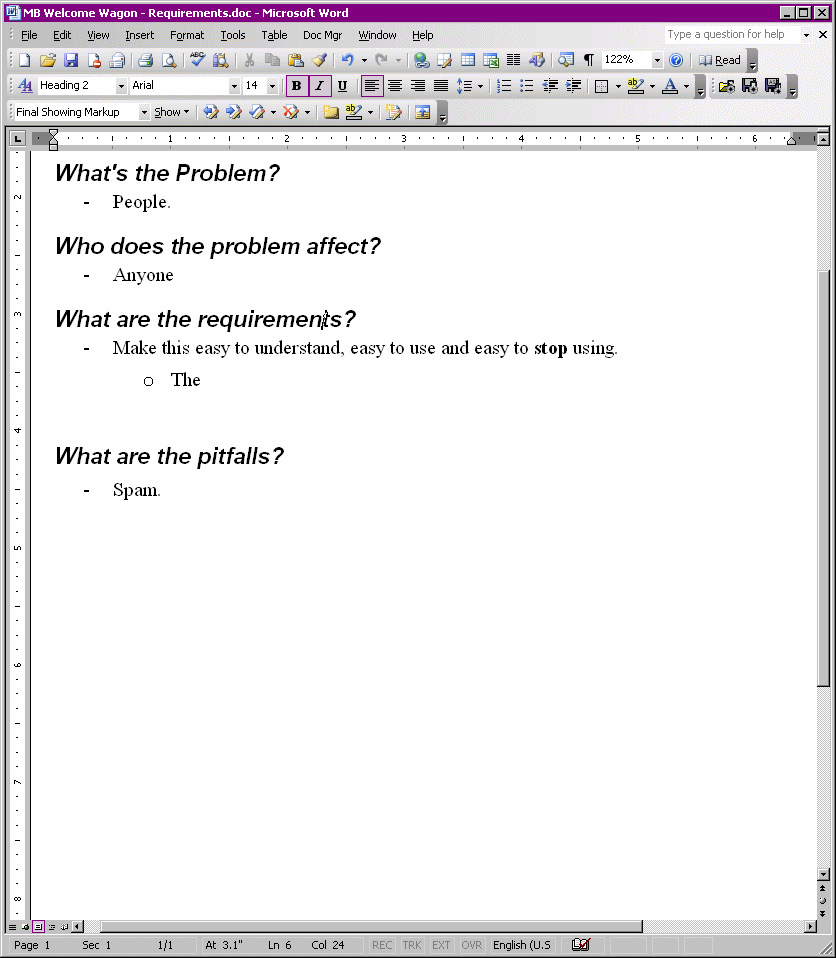
The other day, I was about to begin writing requirements for a project I've wanted to do for some time. It's a special Welcome Wagon project for the online communty of parents I help foster over at SchwabLearning.org. The idea is to alert special volunteers when someone has posted to our board for the very first time who will then be sure no newbie is left behind.

I often start documents by taking previous ones and ripping out the writing, retitling it and then start the work I need. It helps keep my documentaiton format consistent. My initial requirements docs answer these simple questions before we start working on the design: what is the problem, who is impacted by the problem, what's the solution and are there any pitfalls? Well, I grabbed a document about email subscriptions and started tearing it out to leave just the structure.

Then I looked at it again:


I'm going to Community Manager Hell.

Thursday, July 13, 2006

SecondLife for Nonprofits - Two Mixed Reality Events

Two seperate groups inspired by the Net Squared gathering of web innovators who promote social change are holding back-to-back events to discuss the potential of nonprofits making effective use of the virtual world platform, SecondLife.

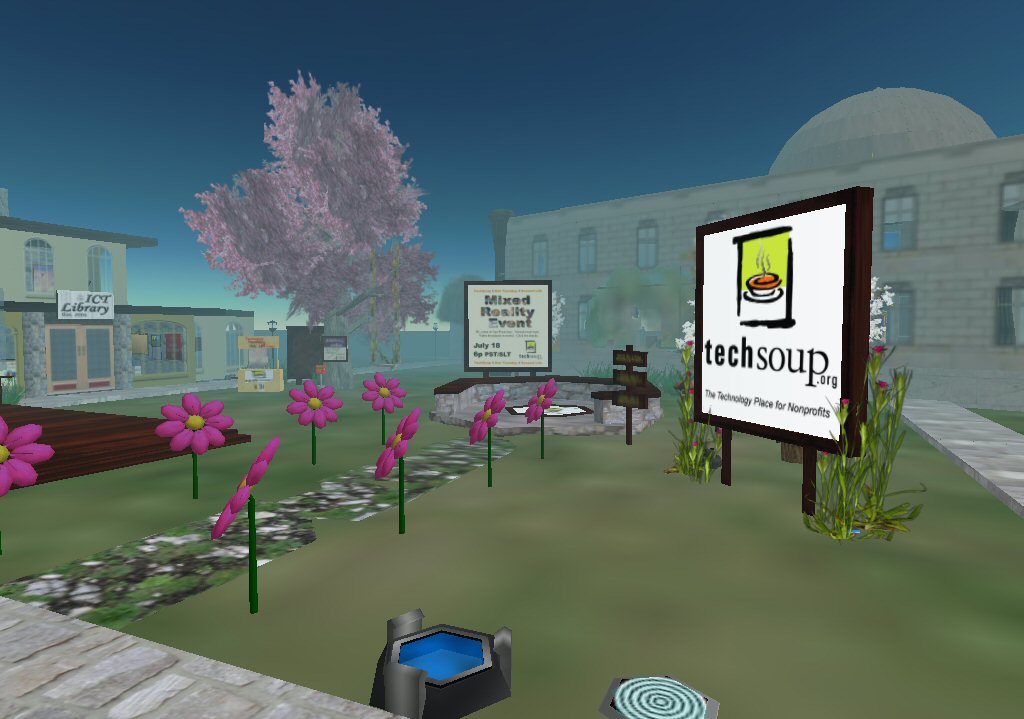
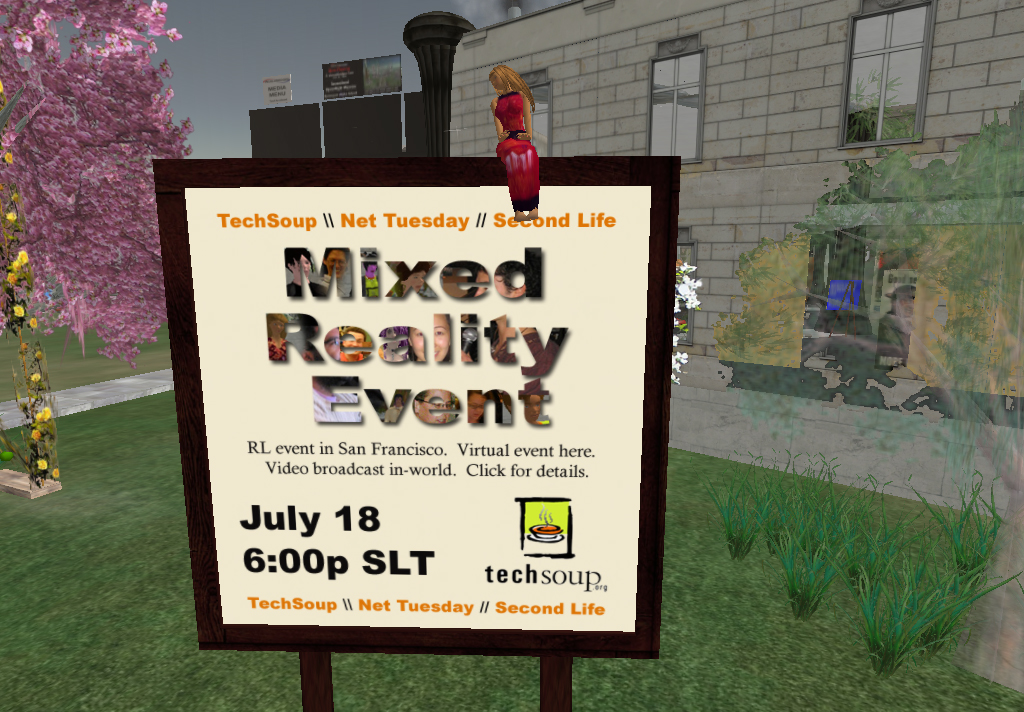
Both are on July 18, 2006. Both take place partially inside SecondLife at the TechSoup online meeting space. BUT they each will be holding a simultaneous meeting in the physical world with video and audio being passed between the online and phsycial meeting spaces so both sets of participants can see and hear each other.

First up on July 18 at 3:30pm Pacific/6:30pm Eastern, the Ethos Roundtable will feature an introduction to Second Life. John Lester, Community Manager at Linden Lab, (the company that created and runs Second Life), will present a tour of this online community including how Second Life can be used for educational and non-profit work. John will have slides and also give an in-world demo to show you how Second Life works.

Ethos Roundtable event physical location:
77 Huron Avenue (Yahoo!Maps)
Cambridge, MA

Soon after that at 6:30pm Pacific/9:30pm Eastern, TechSoup will present on how nonprofits can effectively use SecondLife. Susan Tenby, Online Community Manager of TechSoup.org, and Jeska Dzwigalski, Community Manager at Linden Lab will also present a tour of this online community, including TechSoup's satellite office and demo a directory of nonprofit organizations in the Second Life world. The event will feature a number of guest speakers from organizations who are actively working in the Second Life community to better achieve their organization's missions.

I'll be attending the TechSoup event in both the physical and online sense. I'm easy to spot in SecondLife as I made my avatar look like me (though avatar customization hasn't quite caught up with my actual beard growth).

TechSoup event physical location:
Net^2 HQ
322 Ritch St. 2nd Floor (Yahoo!Maps)
San Francisco, CA
415-633-9446

BOTH events take place online in the same online location. Go directly to the TechSoup area in SecondLife by following this SLurl:
http://slurl.com/secondlife/InfoIsland/52/171/33/

To ensure smooth operation of the online event, the organizers will restrict the TechSoup space to 50 members, and they will allow those in on a first-come-first-serve basis. Arrive early to secure your spot.

You will need to download (25-50MB) and register (free) for SecondLife to visit the online location. I strongly recommend you make sure you can run SecondLife early as it has some fairly strict system requirements.

Once you get started, take a look at the SecondLife Wiki for some more info on how to operate SecondLife. (Or just hit o get the chat input and start asking people for help.)

Also read what some nonprofits, innovators and activists are doing in SecondLife.

Other folks who blogged recently about nonprofits in SecondLife:

Non-profits in Second Life at Omidyar Network

Nonprofit Life in Second Life at Spare Change

Announcing the TechSoup Second Life Event: July 18th at 6:00 PM PST at Beth's Blog

Second Life for Nonprofits at sufolla - community weavers

Tech Soup to offer mixed reality event in person and in second life at Second Life Library 2.0

Monday, May 08, 2006

Are you drinking the Metaverse Kool-Aid?

Over the past year, I've been encountering more and more people enthusiastic about the potential of a Metaverse in the vein of Neal Stephenson's Snow Crash. Today, we have the Metaverse Roadmap project and an Open Source Metaverse Project. Break out the Kool-Aid because it's deja-vu all over again.

I first read Snow Crash 10 years ago as required reading for working on VZones (nee WorldsAway) and, at the time, I was struck by the dystopia that Stephenson develops in contrast to his Mardi Gras vision of the Metaverse. I was particularly mindful that what made the virtual world so alluring was that the physical world was such a economic, political and social mess. It seemed to me that people in the novel entering the Metaverse were seeking something the bleak logo-festooned burbclave reality could not offer, whether it was entertainment/distraction or connection/contacts. It was in a very palpable way a Hyperreality - an idealized imitation or simulation of reality that, through it's simulation, is better than the real thing. Disney's Main Street USA is a hyperreal vision of America. Historical reenactment is a hyperreal vision of history.

After the most recent Game Developers Conference, I felt the urge to pick up Snow Crash once again, just to see if perhaps the years had added additional layers to my view that the Metaverse was not a practical vision for wide-reaching socialization technology. I can say that the years did little to change my view. If anything, the intervening years of text messaging, blackberries, and other mobile connectivity devices that are incapable of rendering 3d polygons, but are great at simply and quickly connecting people reinforce my opinion that modeling after the Metaverse as technology, tends to blind folks to the social implications.

In other words, regardless if you want to bring people together online for economic reasons, political reasons, cultural reasons or social reasons, don't be distracted by blue technology such that you forget why you are doing it in the first place.

Wednesday, March 15, 2006

I could use your help with a design

So I actually convinced my foundation that getting public feedback on designs is a good idea.

It's not an earth-shattering feature. It's just some functionality to help one registered member of a site send their email address to another registered member.

See, families of kids with learning and attention problems face more than just educational and emotional or social challenges. They are often in conflict with schools, sometimes with spouses and sometimes defending their children from law enforcement or child protective services. Any of these can lead to court, but even before then, parents are very very concerned that their lives will be *too* exposed. Over 2/3rds of our registered members have chosen to *not* display their email on their public profile. 'Nuff said.

So given that parents generally know each other only by their screen names, how can I help them make a better contact so they can have private conversations with other parents?

Before you even ask, private messaging is not one of our options.

The main reason we aren't opening up PM is that we don't want to host all those messages. Harassment, illegal behavior and all sorts of problems can occur via PM and to avoid having our time sucked up by hearsay arguments, we should keep a record of every PM and *that* opens us up to a lot of responsibility that our small shop just can't handle.

Another reason is that I am blissfully free trying to pump up our site traffic. My goals are measured in lives affected so I don't have to inflate traffic. If two people meet and go off into email to work out problems, great stuff.

So the challenge is to limit the interaction, give control over the personal information and the interactions to the members and minimize the ability to break it for nefarious purposes. Here's where my community minded friends come in.

I would really appreciate it if you could take some time to look at the design I am working on and offer your insight and feedback. Have I plugged the holes? Are there more elegant ways of handling this? Take a look at my Parent to Parent Email Exchange Design.

You can comment here, email me or join our parents in the discussion where they are offering their views something to be built for their needs.

Tuesday, November 15, 2005

Virtual World Celebrates 10 Year Anniversary

Today at 5PM Pacific Standard Time, the virtual world Dreamscape running on the VZones platform will be officially 10 years old.

Dreamscape circa 1995

From 1995 to 1998, I was one of the community managers and honestly, I didn't expect the place to still be around. Fujitsu had sunk several million dollars into a new version of the Habitat world. The idea was that it could be a platform which could be licensed to others who would build and maintain their own worlds. In order to convince the world that the platform was a place for viable online communities within a virtual environment, a flag-ship product was planned. The profitability of this flag-ship community was always on the mind of Fujitsu and there were times the whole project was almost scuttled before it launched.

Oracle Uni, Oracle Teresias (Me) and Oracle Vaserius welcome Brother Echo (bald man in the back) to being a World Manager (1998)

So, it's really wonderful to see that, 10 years later, much of the central planning over user created content has been decentralized. When we started, there were few objects that did things and little artwork to keep the illusion of variety fresh. 10 years ago, there were 3 Oracles inside the world "managing" the social and physical layout of the world who oversaw about 20 volunteer Acolytes helping settle dispute and handle serious troublemakers. Today, the official staff roster includes Director, World Managers, Senior Oracles, Oracles, Acolytes and Acolyte Painters, or roughly 60 people.

But that's not all, some of these staff are responsible for helping guide Pans, Proprietors, Mages, Muses, Creators, Natives, Welcomers, Security Bears, Jesters, Thespians, Sprites. I don't know how many people are on the rosters of each of these. But that's not the important bit part. These volunteer subgroups fall into two basic categories: content creators and support. Mages, Muses and Natives and the other fantasy named groups create stories of the world, often retelling events that actually happened. The Proprietors, the Welcomers and the Security Bears support the trade of objects, the integration of newcomers and crime prevention education.

While it's not fully decentralized, the inverse pyramid of support where the world director supports, the world managers who support the volunteer groups who support everyone else is much, much bigger and more capable that what we were doing 10 years ago. The key to this little virtual world hanging in there for 10 years is that the people inhabiting the world have many more opportunities to have a lasting effect on the world and others who come after them. The world is much more vibrant than when I was there 7 years ago and it shows.

Dreamscape in 2005

You've come a long way baby. Here's to you!

Friday, September 23, 2005

Community Indicator - Unconditional Support

I really wanted to keep going with my Darkside Community Indicators, but this is something that was hard to ignore.

While discussions with titles like, "I need a hug" aren't uncommon, they tend to have an explanation of why the person is seeking support. Not this time, the entire entire first post of this discussion is, "Can I ask for a hug without posting in details what I'm going through? Thanks....". What follows are 27 messages of unconditional acceptance and support.

It's moving in it's simplicity.

Wednesday, August 31, 2005

The Dark Side of Community Indicators

For a while Nancy White has been blogging about Community Indicators - "patterns of group member behavior that help us pay attention to the emergence and life of a community".

In that post she says,
Indicators are not all strength-based. Like anything, there is the light and dark of community and light and dark of a community’s indicators. This is not the utopian view. Dark indicators might include signs of exclusion, power and control struggles, banning and red-lining.
In other words, "lynch mobs are emergent behavior too". (And profound apologies to the well spoken sociologist who blogged that about two years ago, I can't seem to find the reference.)

I'd like to propose a few community indicators that, on the surface, might seem to counter idea of community, but if we back off from the light/dark binary descriptions, we may see people working together to foster community among themselves.


Community Indicators: Petitions
Online petitions have a bad reputation as not only futile but dangerously becoming a substitute for action. In a large context, they may best serve as raising awareness of an issue, but in a smaller context, they can help strengthen the ties of individuals and their group identity even when they are unsuccessful.


Community Indicators: Protest
Protest is about a group of people coming together with a unified purpose to join their voices and actions to affect change. This one is from my personal archives:
In February 1996, users on Worlds Away got so riled over delays in getting private spaces ("turfs") that they staged a sit-in. Fed up with many delays from WorldsAway's then owner, Fujitsu, avatars filled the locales where new users first arrive in the world, standing and chanting, "No turfs, no peace . . ." (the words scroll up above the game's window)-while paying per-minute online charges. To Kollock, that protest was a sign of WorldsAway's success as a community. "The simple fact that they had a protest speaks volumes about the space-the commitment and collective action."
-From Chapter 2 of From Anarchy to Power: The Net Comes of Age by Wendy Grossman,


Community Indicators: Mass abandonment
How can leaving a group be an indication that there is a community? When it's done by a group:
"So many of us don't have a gathering place that feels comfortable and communal," [Sherry Turkle] said. "For those who found that on Flickr.com, its transformation into a 'service' on Yahoo is a loss; they are losing something important to them.

In this case it's the loss of community feeling that is prompting some to protest against. I think the true test if this really is a community indicator is if those who leave, group together again somewhere else.